
IT setup checklist for a new business in South Africa
A practical IT setup checklist for new South African businesses covering hardware, networking, security, cloud, backups and user policies to start securely and efficiently.
 Tash Bhairo11 September 20265 min read
Introduction
Starting a new business in South Africa means juggling customers, compliance and cashflow. One critical area that’s often underestimated is IT. Getting your technology right from day one reduces costly downtime, protects client data and keeps your team productive. This IT setup checklist for a new business walks South African small and medium-sized businesses through practical steps to set up reliable, secure and scalable IT.
1. Define your business needs
A clear understanding of needs prevents over- or under-investment. Start by answering core questions:
- What applications will staff use daily (email, accounting, CRM)?
- How many users and devices will you support now and in 12–24 months?
- What regulatory or industry requirements apply (POPIA, financial reporting)?
Documenting these requirements informs choices on hardware, connectivity, cloud services and security.
2. Hardware and devices
Choose devices that match job roles and budget. Prioritise reliability and warranty support.
Essential hardware
- Business-grade laptops or desktops with adequate RAM and SSD storage.
- Peripherals: monitors, keyboards, mice, headsets for remote calls.
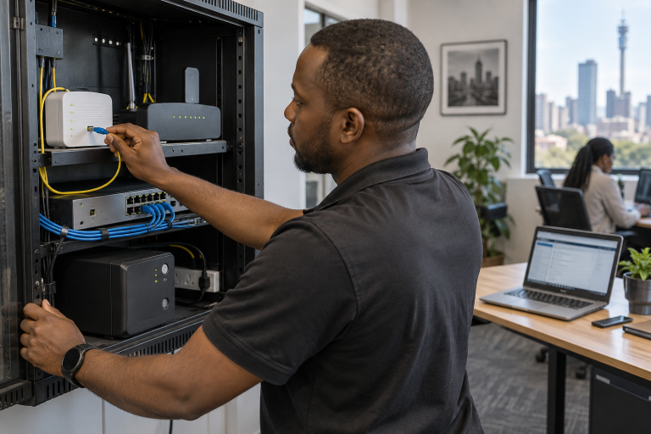
- Network hardware: a business-class router and managed switch if you have multiple wired devices.
- Uninterruptible Power Supplies (UPS) for critical equipment like servers and core networking devices, especially in areas prone to load-shedding.
Local considerations
In Gauteng and Johannesburg, expect stable metropolitan connectivity but plan for load-shedding and occasional outages. UPS and graceful shutdown procedures protect data and hardware.
3. Internet and networking
Connectivity is business-critical. Treat your network as a priority, not an afterthought.
Choose the right connection
- Assess available links: fibre, fixed wireless, LTE. Fibre is ideal where available for its reliability and speed.
- Consider a secondary backup connection (LTE) for failover during primary outages.
Secure your network
- Use business-class firewalls and enable regular firmware updates.
- Separate guest Wi‑Fi from internal networks and use WPA3 if supported.
4. Cloud services and software
Cloud services reduce upfront costs and simplify management, but choose and configure them carefully.
Common cloud choices
- Email and collaboration: Microsoft 365 or Google Workspace for business email, calendars and document collaboration.
- Accounting: cloud accounting software that integrates with your bank and tax workflows.
- File storage and backups: choose a cloud storage provider with versioning and encryption.
Licence and cost control
Purchase business licences rather than consumer plans for support and compliance. Track licences centrally to avoid unexpected renewals or gaps.
5. Security and compliance
Security is not optional. Implement layered controls to protect data and reputation.
Technical controls
- Endpoint protection: install reputable antivirus/EDR on all devices.
- Multi-factor authentication (MFA): enforce MFA for email, admin accounts and cloud services.
- Patch management: ensure operating systems and applications receive timely updates.
Policies and awareness
- Create clear acceptable use, password and remote access policies.
- Train staff on phishing, social engineering and safe data handling—regular short sessions are more effective than one-off training.
6. Backup and disaster recovery
Backups are your last line of defence against data loss and ransomware. Make a plan and test it.
Backup best practices
- 3-2-1 rule: keep at least three copies of data, on two different media, with one offsite copy.
- Automate backups and verify restorability with periodic restore tests.
- Consider cloud backups with immutable snapshots to protect against ransomware.
7. User accounts and permissions
Limit privileges and centralise account management.
Account setup
- Create individual user accounts—avoid shared logins for accountability.
- Use role-based access controls (RBAC) to grant least privilege required for tasks.
- Regularly review and deactivate accounts for former staff or contractors.
8. Backup communications and continuity planning
Prepare for scenarios where normal channels fail. A simple continuity plan reduces panic and enables faster recovery.
Practical steps
- Maintain an emergency contact list with vendors, ISP and key staff numbers.
- Document recovery procedures for critical systems and store them securely offline.
- Plan for remote work contingencies with VPN or secure remote desktop solutions.
9. Vendor selection and contracts
Choose suppliers who understand SME needs and offer clear SLAs.
What to look for
- Fast response times and experienced engineers—avoid suppliers that learn on your time.
- Clear pricing and scope for installation, support and maintenance.
- References from local businesses and experience with South African compliance (POPIA).
10. Ongoing management and monitoring
IT setup is not a one-time task. Continuous management keeps systems healthy.
Recommended activities
- Implement remote monitoring and management (RMM) for proactive alerts.
- Schedule regular maintenance windows for updates and reviews.
- Conduct annual IT reviews aligned to business growth plans and budgets in ZAR.
FAQ
How much should a small business budget for initial IT setup?
Costs vary by requirements. Budget for reliable hardware, business internet, licensing and a basic security stack. Get quotes tailored to your user count and services rather than relying on off-the-shelf estimates.
Do I need an on-premises server?
Most new SMEs can use cloud services instead of on-premises servers. Consider local servers only if you have specific latency, compliance or legacy application needs.
How often should backups be tested?
Test backups at least quarterly, or more frequently for critical systems. A verified restore is the only proof a backup strategy works.
Can I use consumer-grade Wi‑Fi and equipment?
Consumer devices may be cheaper but lack business features, security and support. For reliability and manageability, choose business-grade networking equipment.
What is the minimum security I should implement on day one?
At minimum: enforce MFA, install endpoint protection, keep systems patched, and implement secure passwords and account controls.
Conclusion
An organised IT setup protects your new business from avoidable downtime, security incidents and unnecessary costs. Addressing hardware, connectivity, cloud choices, security and backups from the start makes IT an enabler for growth, not a recurring headache.
If you need practical, experienced help to implement this IT setup checklist for your South African business, RandTech IT can assist. Our engineers prioritise fast, expert resolution so you can focus on running your business—contact RandTech IT to get started.
Tash Bhairo
Tash Bhairo leads Randtech IT with nearly two decades of hands-on experience in business support, infrastructure, cloud systems and software development.
Related Insights

How Social Engineering Turns a Trusted Identity Into Payment Fraud
The most dangerous part of an online scam is often not the technology. It is the relationship the…
Cloud Services Still Need a Business Continuity Plan
The debate concerns national infrastructure and development policy, but it also highlights a simpler lesson for small businesses:…

Windows 11 Bluetooth Problems: Fix the Cause Before Replacing Hardware
A wireless headset that stutters, a mouse that disconnects or a laptop that shows the wrong Bluetooth status…