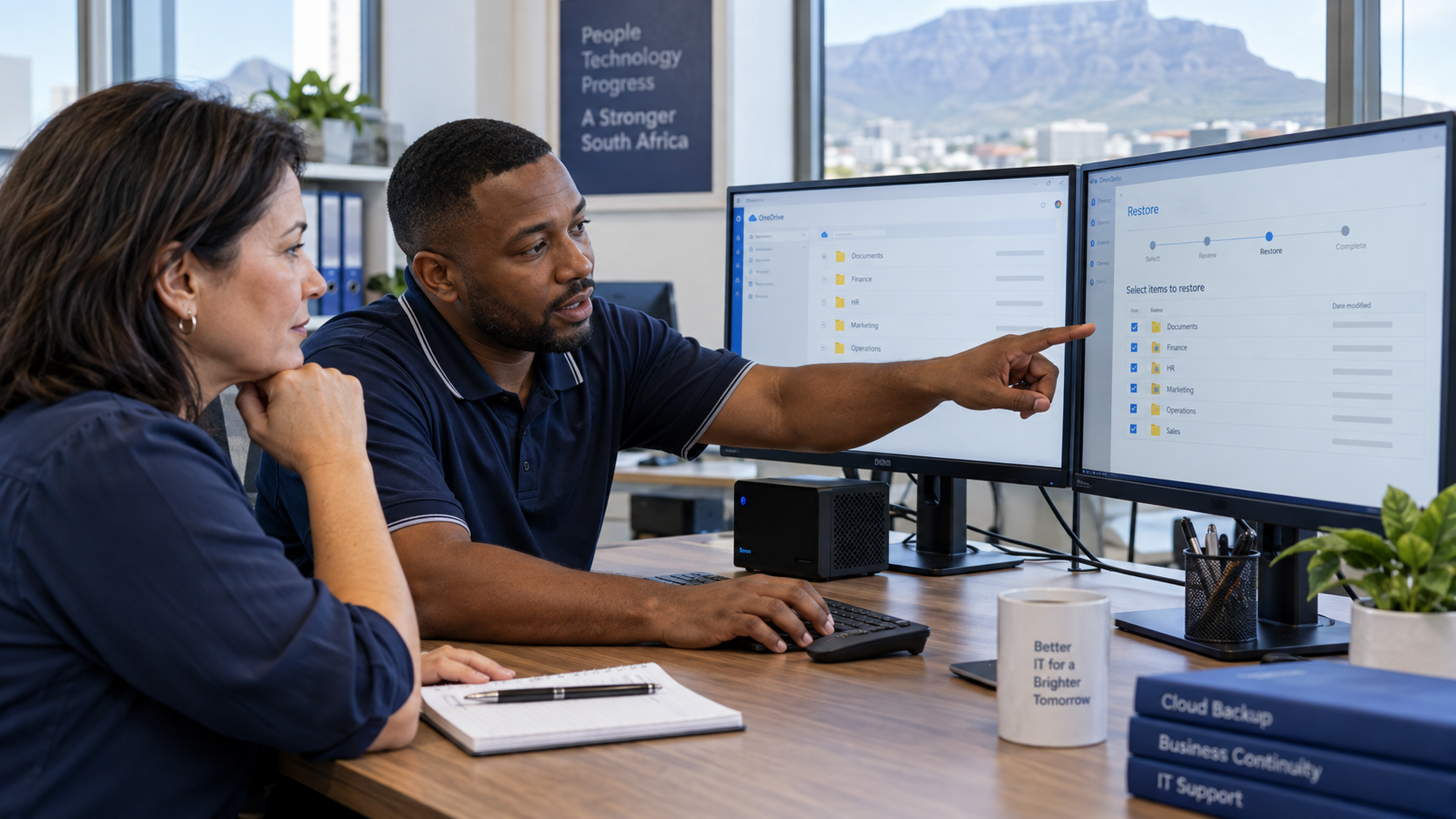
Category: Cybersecurity

  • Microsoft 365 Backup Retention Explained for SA SMEs

    Microsoft 365 Backup Retention Explained for SA SMEs

    Introduction

    Understanding Microsoft 365 backup retention explained is essential for South African small and medium-sized businesses. Many organisations assume Microsoft fully protects their data, but the reality is more nuanced. This article explains what Microsoft covers, common gaps, recommended retention strategies for SMEs, and practical steps you can take in Gauteng and across South Africa to reduce risk and meet compliance needs.

    What Microsoft 365 covers — and what it doesn’t

    Microsoft provides a range of built-in data protection features across Exchange Online, SharePoint, OneDrive and Teams. These include versioning, retention policies, and basic recovery options. However, Microsoft’s shared responsibility model means customers retain responsibility for long-term retention, point-in-time recovery, and protecting against accidental deletion, malware and insider threats.

    Included features

    • Version history for files in OneDrive and SharePoint.
    • Recycle Bin retention for deleted items (limited timeframes).
    • Retention labels and policies for compliance scenarios.
    • Basic restore tools for administrators.

    Common gaps to be aware of

    • Microsoft is not a true backup provider — point-in-time restores beyond the retention windows can be difficult.
    • Deleted items may be purged after the recycle bin period, making recovery impossible without backups.
    • Ransomware and mass-deletion attacks can propagate through connected services.
    • Regulatory or contractual retention requirements may exceed Microsoft’s default settings.

    Key retention concepts explained

    To make sensible retention decisions, SMEs should understand a few core concepts:

    Retention policies vs backups

    Retention policies prevent deletion or preserve data for a set period to meet compliance needs. Backups create independent copies that allow point-in-time restores even if original items are modified or removed.

    Versioning and point-in-time recovery

    Versioning keeps prior versions of files, but it is not a substitute for backup because versions can be removed or become impractical for large-scale recovery.

    Retention periods

    Retention periods should reflect legal, tax and operational requirements. In South Africa, businesses may need to retain financial records or employment documents for several years — often longer than Microsoft’s default windows.

    Practical retention strategies for South African SMEs

    Apply a layered approach combining Microsoft capabilities with independent backups to achieve resilience and compliance.

    1. Assess legal and operational requirements

    • Identify documents and mailboxes that require long-term retention (e.g., tax records, contracts).
    • Confirm retention durations dictated by SARS, labour regulations or industry rules.

    2. Configure Microsoft 365 retention and labels

    • Use retention labels to classify content and apply minimum retention and deletion rules.
    • Apply policies to SharePoint sites, OneDrive accounts and Exchange mailboxes where appropriate.

    3. Implement third-party backups

    Choose a backup solution that offers:

    • Automated, scheduled backups of Exchange, SharePoint, OneDrive and Teams.
    • Point-in-time restore capability and long-term archival storage.
    • Encryption in transit and at rest, with reliable role-based access for restores.

    4. Define retention tiers and storage locations

    • Short-term tier: quick restores for operational continuity (days to months).
    • Long-term tier: archival storage for compliance (years). Consider on-prem or local region cloud storage for data sovereignty concerns.

    5. Test restore procedures regularly

    Backups are only useful if restores work. Schedule regular restore tests to validate procedures, timing and data integrity.

    Cost considerations for SMEs in South Africa

    Budget realistically. Backup costs vary by provider, retention period and storage class. For many SMEs the goal is to balance affordability with risk tolerance. Factor in:

    • Monthly subscription fees for backup software or services.
    • Storage costs for long-term archives.
    • Internal time to manage and test backups.

    Discuss options with your IT partner to compare local versus international storage, and any implications for data access speeds and compliance.

    Checklist: Implementing a robust Microsoft 365 retention plan

    1. Audit current Microsoft 365 settings and data types.
    2. Map legal and business retention requirements.
    3. Apply retention labels and policies where possible.
    4. Deploy an independent backup solution for point-in-time recovery.
    5. Define retention tiers and archival locations.
    6. Test restores quarterly and after major changes.
    7. Document procedures and assign responsibilities.

    FAQs

    Do I need a separate backup if I use Microsoft 365?

    Yes. Microsoft protects platform availability and provides some data retention tools, but it does not replace dedicated backups for long-term retention or comprehensive point-in-time recovery.

    How long does Microsoft keep deleted Exchange items?

    Retention for deleted items depends on mailbox settings and retention policies. Default recycle bins are time-limited and may not meet all compliance needs, so verify and extend retention where required.

    Can I meet SARS or labour retention rules with Microsoft retention policies?

    Possibly, but you should confirm that applied retention periods and auditability match statutory requirements. Independent backups provide stronger assurance for long-term legal holds.

    Is local (South African) storage necessary?

    Local storage can help address data sovereignty concerns and may reduce latency. Whether it’s necessary depends on your industry, contractual obligations and risk appetite.

    How often should I test restores?

    Test restores at least quarterly, and after any significant change to your environment or backup configuration.

    Conclusion

    Microsoft 365 backup retention explained shows that while Microsoft provides useful tools, SMEs must take active responsibility for long-term retention and recoverability. By combining retention policies with independent backups, clearly defined retention tiers, and regular restore testing, South African businesses can minimise risk and meet compliance requirements without disrupting operations.

    If you’d like practical help implementing or reviewing your Microsoft 365 retention and backup strategy, contact RandTech IT. Our experienced engineers provide fast, effective support so you get reliable protection without learning on your time.

  • Backup vs Business Continuity: What’s the Difference?

    Backup vs Business Continuity: What’s the Difference?

    Introduction

    Many South African small and medium-sized businesses use the terms “backup” and “business continuity” interchangeably. That can be costly. While both aim to protect data and keep operations running, they serve different purposes and require different planning. This article explains the difference, why each matters for SMBs in South Africa, and practical steps you can take to reduce downtime and recover quickly.

    What is a Backup?

    A backup is a copy of data or systems stored separately so you can recover information after data loss. Backups protect against accidental deletion, hardware failure, ransomware, or corruption.

    Common backup types

    • Full backups: Complete copy of selected data. Simple to restore but storage-intensive.
    • Incremental backups: Only changes since the last backup. Saves storage and time but can lengthen restores.
    • Differential backups: Changes since the last full backup. A middle ground between full and incremental.
    • Image-based backups: Capture entire system images, useful for quick server or workstation restoration.
    • Cloud backups: Offsite copies held by providers—scalable and often faster to deploy.

    What backups achieve

    • Restore lost files and databases.
    • Recover after ransomware (if backups are clean and isolated).
    • Meet compliance and retention requirements.

    What is Business Continuity?

    Business continuity (BC) is a broader discipline that ensures critical business functions continue during and after a disruptive event. It combines people, processes, technology and communication plans so your organisation can operate at an acceptable level while full recovery takes place.

    Key components of business continuity

    • Business Impact Analysis (BIA): Identifies critical processes and acceptable downtime.
    • Continuity strategies: Alternate work arrangements, redundant systems, and supplier contingency plans.
    • Communication plans: How you notify staff, customers and suppliers during incidents.
    • Testing and exercises: Regular drills to ensure procedures work in practice.

    What business continuity achieves

    • Maintains customer service and revenue streams during incidents.
    • Reduces the operational impact of disasters, power outages or cyberattacks.
    • Protects reputation by demonstrating resilience and preparedness.

    Backup vs Business Continuity: Side-by-side

    Think of backups as one essential tool inside a business continuity toolbox. Backups restore data; business continuity keeps the business running. Comparing them directly highlights their distinct roles.

    Focus

    • Backups: Data and systems recovery.
    • Business continuity: Operational resilience and process continuity.

    Recovery time objective (RTO) and recovery point objective (RPO)

    RTO and RPO are central to both planning disciplines but are applied differently:

    • RPO (how much data you can lose): Set backup frequency to meet RPO.
    • RTO (how long you can be down): Guides continuity strategies, such as failover systems or temporary workarounds.

    Cost and complexity

    Backups alone are usually less complex and cheaper to implement. Comprehensive business continuity often requires additional investment—redundant connectivity, secondary sites, cloud failover and staff training—but delivers far greater resilience.

    Practical Steps for South African SMBs

    SMBs in South Africa face specific challenges: load-shedding, variable internet reliability, physical security risks and increasing cyber threats. A pragmatic approach balances cost, complexity and risk.

    1. Start with a simple BIA

    Identify the processes that generate revenue or are legally required. Determine acceptable downtime and potential costs of interruption in rand (R). This gives you priorities for backups and continuity investments.

    2. Implement a 3-2-1 backup strategy

    • Keep at least three copies of data
    • Store copies on two different media
    • Keep one copy offsite (cloud or physically separate location)

    3. Harden backups against ransomware

    • Use immutable or air-gapped backups where possible.
    • Test backups regularly to ensure data integrity.

    4. Plan for power and connectivity issues

    Consider UPS systems, backup generators and multiple internet providers. For Johannesburg/Gauteng businesses, redundant ISP links and mobile failover can reduce disruption during load-shedding or local outages.

    5. Create simple continuity playbooks

    Produce short, actionable guides for incidents: who to contact, how to switch to cloud services, remote-work instructions, and where key backups are stored. Make these accessible offsite and print copies for key personnel.

    6. Test regularly and update

    Conduct tabletop exercises and full restore drills at least annually, or after major changes. Testing exposes gaps and builds staff confidence.

    How Managed IT and MSPs Help

    Many SMBs lack the in-house resources to plan and maintain robust continuity. A managed service provider can:

    • Design backup architectures aligned with RPO/RTO targets
    • Manage offsite and cloud backups with encryption and immutability options
    • Implement failover solutions and remote access for quick continuity
    • Run regular tests and provide incident response expertise

    Working with experienced engineers reduces risk and speeds recovery—especially when you need resolution fast rather than long vendor learning curves.

    Cost Considerations for SMBs

    Budgeting for backup and continuity should be risk-based. Compare the estimated cost of downtime (lost revenue, fines, reputational damage) with the cost of solutions. Small businesses in South Africa often start with cloud-based backups (monthly costs in rand) and scale into continuity services as they grow.

    Conclusion

    Backups and business continuity are complementary. Backups recover data; business continuity keeps the business operational during incidents. For South African SMBs, a practical, tested plan that combines reliable backups, clear continuity playbooks and fast-response technical support is the best way to reduce downtime and protect your business.

    FAQ

    • Q: Can backups alone provide business continuity?

      A: No. Backups help you recover data but don’t guarantee continued operations. Continuity requires processes, alternate access methods and communication plans.

    • Q: How often should I test backups?

      A: Test restores at least quarterly and perform a full recovery drill annually, or after major system changes.

    • Q: What is a reasonable RTO for an SMB?

      A: That depends on the business. Critical services may need RTOs measured in minutes to hours; less critical functions might tolerate days. Use a BIA to decide.

    • Q: Are cloud backups safe for South African businesses?

      A: Yes, when properly configured with encryption, access controls and regional redundancy. Ensure your provider meets legal and data residency needs.

    • Q: How much will business continuity planning cost?

      A: Costs vary by scope. A basic plan with cloud backups and simple continuity playbooks can be affordable for SMBs. More advanced failover and redundant infrastructure will cost more but may be justified by reduced downtime losses.

    If your business needs practical, experienced assistance to implement reliable backups and a realistic continuity plan, contact RandTech IT. Our engineers focus on fast resolution and proven solutions to keep your business running.

  • Disaster-recovery checklist for SMEs in South Africa

    Disaster-recovery checklist for SMEs in South Africa

    Introduction

    Every small or medium-sized business (SME) in South Africa needs a practical, tested disaster-recovery checklist. Whether the threat is a ransomware attack, hardware failure, accidental data deletion or a localised power outage in Johannesburg, a clear plan reduces downtime, financial loss and reputational damage. This guide gives SMEs a step-by-step checklist that’s easy to implement and relevant to South African business contexts.

    Why a disaster-recovery checklist matters for SMEs

    SMEs often lack the redundancies of larger firms, so the immediate impact of an IT incident is greater. A concise checklist helps prioritise actions, align people and technology, and set realistic recovery expectations. It also supports compliance with client requirements and industry standards where applicable.

    Core components of the checklist

    Use the sections below to build a tailored plan. Keep documents accessible off-site and review the checklist at least annually or after any significant infrastructure change.

    1. Inventory and critical asset identification

    • List all critical systems: servers, workstations, network devices, cloud services and specialised business applications.
    • Classify data by importance: financial records, customer data, contracts and intellectual property.
    • Record owner and contact for each asset—who is responsible during an incident.

    2. Define recovery objectives

    • Recovery Time Objective (RTO): maximum acceptable downtime for each critical system.
    • Recovery Point Objective (RPO): acceptable data loss measured in time (e.g., last 4 hours).
    • Set realistic targets based on cost, technical complexity and business impact.

    3. Backup strategy

    • Adopt the 3-2-1 rule: three copies of data, on two different media, one copy off-site or in the cloud.
    • Use automated backups with monitoring and regular test restores. Manual backups are vulnerable to human error.
    • Store off-site backups in a secure Gauteng or national cloud region to meet locality needs and latency considerations.

    4. Incident response and communication

    • Assign incident roles: incident lead, technical lead, communications lead and external liaison (e.g., managed service provider).
    • Prepare communication templates for staff, customers and suppliers. Keep contact lists current and accessible offline.
    • Decide thresholds for involving external specialists or law enforcement (e.g., confirmed ransomware).

    5. Access control and credentials

    • Maintain a secured credentials vault for emergency access with multi-factor authentication (MFA).
    • Document privileged accounts and procedures to revoke or rotate credentials after an incident.

    6. Network and perimeter controls

    • Identify network segmentation points and quick ways to isolate affected segments.
    • Have a plan to switch to secondary internet links or mobile connectivity to maintain critical communications.

    Testing and validation

    A checklist is only useful if it works. Regular testing uncovers hidden dependencies and clarifies timelines.

    Runbook drills

    • Conduct tabletop exercises with the incident team to walk through scenarios (ransomware, disk failure, office flood).
    • Perform full restores from backups at least annually for business-critical systems. Record restoration time and issues.

    Post-incident review

    • After any test or real incident, document lessons learned and update the checklist accordingly.
    • Track improvements and assign owners to close identified gaps.

    Practical considerations for South African SMEs

    Local context influences practical decisions. Consider the following:

    • Power stability: include UPS and graceful shutdown procedures for on-premises servers, especially where load-shedding is a risk.
    • Connectivity: plan for switching to alternative ISPs or mobile networks if a primary provider fails in Gauteng or other business hubs.
    • Cost management: balance recovery targets against budget—identify critical services that justify higher protection.

    Working with an IT partner

    Many SMEs benefit from partnering with experienced managed service providers rather than handling every technical task internally. An external partner can offer:

    • Proactive monitoring and rapid incident response by experienced engineers.
    • Secure off-site backups and regular restore testing.
    • Clear escalation pathways to reduce mean time to resolution (MTTR).

    Quick disaster-recovery checklist (actionable steps)

    1. Activate incident lead and notify staff using your communications template.
    2. Isolate affected systems or network segments to prevent spread.
    3. Confirm latest valid backup and initiate restore to a clean environment.
    4. Rotate compromised credentials and enable MFA for critical accounts.
    5. Engage your managed IT partner or external specialists if required.
    6. Communicate expected downtime to customers and update as progress is made.
    7. After recovery, run forensic checks where needed and complete a post-incident review.

    FAQ

    How often should SMEs test their disaster-recovery plan?

    At minimum, run tabletop exercises yearly and perform full restores for critical systems annually. More frequent tests are advisable if you change systems or services regularly.

    What’s the minimum backup frequency for a small business?

    Backup frequency depends on RPO. For many SMEs, daily backups suffice, but businesses with frequent transactions may need hourly or continuous replication.

    Can cloud services replace on-premises disaster recovery?

    Cloud services can simplify recovery and reduce on-site hardware needs, but you must still plan backups, access controls and test restores. Ensure your cloud provider’s region and SLAs meet your needs.

    How do we set realistic RTOs and RPOs on a budget?

    Prioritise the most critical systems and set tighter RTO/RPO for those only. Less critical services can have longer windows. Work with an IT partner to model costs for different recovery options.

    When should we involve external specialists?

    Engage external specialists immediately for confirmed ransomware, suspected data breaches, or if internal teams cannot restore critical services within target RTOs.

    Conclusion

    A clear, practiced disaster-recovery checklist reduces downtime and protects revenue and reputation. For South African SMEs, practical measures—regular backups, defined RTO/RPOs, tested restores and fast access to experienced engineers—make the difference between a short disruption and a damaging outage.

    If you’d like practical support building or testing your disaster-recovery plan, contact RandTech IT. Our experienced engineers focus on fast resolution so your business can get back to work without learning on the client’s time.

  • How Much Downtime Can Your Business Afford?

    How Much Downtime Can Your Business Afford?

    Introduction

    When systems go offline, the impact on South African small and medium-sized businesses can be immediate and severe. Beyond lost sales, downtime damages customer trust, disrupts payroll and compliance processes, and diverts staff to firefighting rather than productive work. The critical question is practical: how much downtime can your business afford? This article helps SMEs in Gauteng and across South Africa assess that limit and take realistic steps to reduce risk.

    Understanding downtime: more than minutes lost

    Downtime is any period when critical IT services are unavailable. That includes network outages, server failures, ransomware events and cloud service interruptions. Costs are not only direct revenue loss but also:

    • Lost productivity as staff wait for systems.
    • Reputational damage and customer churn.
    • Regulatory and compliance penalties if records are unavailable.
    • Incident response and recovery expenses.

    Financial vs operational impact

    Financial losses are easiest to estimate, but operational impact—such as delayed projects or missed deadlines—can be longer-lasting. When evaluating affordability, include both immediate and downstream costs.

    How to calculate acceptable downtime

    Determining acceptable downtime starts with two industry concepts: Recovery Time Objective (RTO) and Recovery Point Objective (RPO). Use these as practical tools rather than theoretical targets.

    Step 1: Identify critical systems and processes

    List systems that, if unavailable, cause the most disruption: point-of-sale, accounting, email, ERP, client portals, manufacturing controls, or specialised software. For each, decide whether it is business-critical, important, or non-essential.

    Step 2: Estimate hourly costs

    Calculate a conservative hourly cost for downtime. Include:

    • Lost revenue per hour.
    • Staff wages for idle or redirected employees.
    • Extra costs for temporary fixes or overtime.
    • Projected customer loss or penalties spread over time.

    For many SMEs, the sum quickly rises into thousands of rand per hour—so even short outages matter.

    Step 3: Set RTO and RPO for each system

    RTO is how long you can tolerate downtime; RPO is how much data loss (in time) is acceptable. A point-of-sale system may need an RTO of minutes and an RPO of seconds, while an internal HR portal might tolerate longer windows.

    Common downtime scenarios and realistic tolerances

    Examples help make decisions tangible. Consider these typical SME situations:

    • Retail store in Johannesburg: POS outage during peak hours—RTO under 15 minutes.
    • Professional services firm: email and billing systems down—RTO of a few hours, RPO within a day.
    • Light manufacturing: PLC or inventory system offline—RTO depends on production cycle; often hours are critical.

    These tolerances inform your investments in redundancy, backups and staff training.

    Reducing downtime: practical measures for South African SMEs

    Minimising downtime doesn’t require enterprise budgets. Prioritise targeted, practical measures that align with your calculated RTO/RPO.

    1. Use managed services with SLAs

    Partnering with a managed service provider (MSP) can deliver faster incident response and experienced engineers who resolve issues quickly. Look for clear service level agreements (SLAs) that match your RTOs.

    2. Implement reliable backups and test them

    Backups are only useful if they work. Maintain offsite or cloud backups and run regular restore tests to ensure RPO goals are achievable.

    3. Design simple redundancy

    Redundancy doesn’t have to be expensive. Examples include:

    • Secondary internet connections for failover.
    • Virtual machines that can be spun up quickly in the cloud.
    • Hot or warm spare servers for critical services.

    4. Secure systems to prevent avoidable outages

    Cybersecurity incidents are a leading cause of downtime. Basic measures—patching, endpoint protection, multi-factor authentication and employee training—reduce the risk and potential recovery time.

    5. Maintain vendor and cloud awareness

    Understand the availability guarantees from cloud providers and third-party vendors. Plan for vendor outages by ensuring you can operate in degraded modes or switch providers if necessary.

    Calculating ROI for downtime prevention

    Spend on reliability should be commensurate with avoided losses. A simple ROI check:

    1. Estimate current expected annual downtime cost.
    2. Estimate reduction in downtime with proposed measures.
    3. Compare annualised cost of those measures to the avoided losses.

    If a R50 000 annual spend reduces expected losses by R200 000, it’s likely worthwhile. Use realistic assumptions; don’t rely on worst-case figures alone.

    Incident response and recovery: speed matters

    When incidents happen, fast, experienced response limits damage. An engineer who knows your environment can restore services far quicker than a generalist learning on the job.

    Build an incident playbook

    Document who does what when systems fail. Include contact numbers, escalation paths and step-by-step recovery actions. Regularly rehearse these plans with key staff.

    Case considerations specific to Gauteng businesses

    For businesses in Johannesburg and surrounding areas, additional considerations may include local power stability and network congestion during peak hours. Factor local infrastructure realities into your tolerance calculations and mitigation plans.

    Conclusion

    Knowing how much downtime your business can afford requires a clear inventory of critical systems, honest costing of downtime and realistic RTO/RPO targets. For South African SMEs, practical, tested measures—backups, redundancy, managed services and incident planning—deliver the best balance of cost and resilience.

    FAQ

    How quickly should an SME expect critical systems to be restored?

    That depends on your RTO. For truly critical services, aim for minutes to an hour. For less critical systems, several hours to a day may be acceptable. Match recovery expectations to business impact.

    Can small businesses afford redundancy and managed services?

    Yes. Costs scale, and many managed services packages are designed for SMEs. Prioritise the systems with the highest hourly impact to get the best value.

    How often should backups be tested?

    At minimum, test restores quarterly. Critical systems may need monthly or even weekly validation to meet RPO requirements.

    Will cybersecurity add to downtime risk?

    Poor cybersecurity increases downtime risk. Investing in prevention—patching, MFA, endpoint protection and staff training—reduces both the likelihood and duration of incidents.

    What is the simplest first step for a small business?

    Start with an inventory of critical systems and a basic hourly-cost estimate for downtime. Use that to prioritise quick wins: reliable backups, a documented incident plan and a managed services partner for faster response.

    Call to action

    If you need practical help assessing acceptable downtime and implementing cost-effective resilience, contact RandTech IT. Our experienced engineers focus on rapid, reliable resolution so your business can get back to work—fast.

  • How Often Should a Business Test Its Backups?

    How Often Should a Business Test Its Backups?

    Introduction

    Backups are only useful if they work. For South African small and medium-sized businesses, especially those in Johannesburg and wider Gauteng, knowing how often to test backups is a practical, cost-effective step to protect revenue, reputation and regulatory compliance. This article explains sensible testing cadences, methods, responsibilities and signals that your business needs to test more often.

    Why regular backup testing matters

    Many businesses assume backups are running because software indicates success. However, issues such as corrupt files, misconfigured schedules, incomplete data sets and failed restores can render backups useless when you need them most. Regular testing builds confidence that recovery will work, shortens downtime and reduces the cost of incidents.

    Common risks uncovered by testing

    • Incomplete or corrupt backup files
    • Missing critical data or application dependencies
    • Permissions and configuration errors preventing restores
    • Network bottlenecks or bandwidth limits that slow recovery
    • Human process failures in the recovery runbook

    How often should a business test its backups?

    The right frequency depends on business size, sector, data criticality and recovery time objectives (RTOs). Use the following pragmatic schedules as a starting point and adapt based on risk.

    Recommended baseline schedule

    • Daily verification: Automated checksum or integrity checks for backups that run daily (or more often) to detect immediate failures.
    • Weekly restores: Perform targeted restores of key files, mailboxes or databases weekly to confirm recoverability.
    • Quarterly full restores: Run a full system or full-site restore simulation at least every three months to validate end-to-end recovery.
    • Annual disaster recovery test: Conduct a comprehensive DR test involving business stakeholders to exercise procedures, communications and external suppliers.

    Adjusting frequency by risk profile

    Not every organisation needs the same cadence. Consider these adjustments:

    • High-risk or regulated industries: Financial services, healthcare or businesses with strict compliance obligations may need weekly or even daily full-application restores.
    • High-change environments: Companies with rapid data churn or frequent application updates should increase restore testing to avoid missing dependency issues.
    • Low-risk SMEs: Small operations with limited critical data might accept weekly file restores and less frequent full restores, provided RTOs are achievable.

    Types of backup tests and what to check

    Effective testing combines automated checks with manual restores and business-level exercises. Use a mix of the following:

    Automated integrity checks

    Integrity checks (checksums, verification logs) confirm a backup completed and the files are readable. These should run with every backup job and alert on failures.

    Partial restores

    Restore individual items such as mailbox items, database tables or critical documents. Partial restores are quick and reveal issues with specific data types or permissions.

    Full system restores and sandbox recoveries

    Full restores verify that operating systems, applications and data recover together. Use isolated test environments or cloud sandboxes to avoid impacting production systems.

    Disaster recovery (DR) drills

    DR drills involve business stakeholders and test processes such as communication plans, manual workarounds and supplier coordination. These exercises expose gaps beyond technical restore steps.

    Practical testing process for South African SMEs

    Design a testing process that fits available resources and minimises disruption.

    Step-by-step approach

    1. Identify critical systems and data, and set RTOs and recovery point objectives (RPOs).
    2. Define a testing schedule and assign owners (IT, vendor, or managed service provider).
    3. Automate integrity checks and monitor backup job results daily.
    4. Perform weekly partial restores and log outcomes.
    5. Run quarterly full restores in a test environment and report lessons learned.
    6. Hold annual DR drills with business continuity stakeholders and update runbooks.

    Who should be involved?

    • Internal IT or an external managed services provider (MSP) for technical execution.
    • Business owners for prioritising critical systems and approving RTOs/RPOs.
    • Finance and legal for compliance and cost considerations.
    • Communications or operations for DR drills and stakeholder messaging.

    Cost considerations and efficiency tips

    Testing can be scaled to budget. Here are ways to test effectively without overspending.

    Use incremental and sample-based restores

    Rather than restoring everything each week, select high-value samples from different systems. This finds issues quickly while reducing labour and infrastructure costs.

    Leverage sandbox environments and cloud restores

    Restore into virtual sandboxes or cloud instances to avoid tying up production hardware. This is often cheaper than maintaining duplicate on-premises infrastructure.

    Document and automate

    Automation reduces human error and recurring costs. Maintain clear runbooks so restores are repeatable and can be executed by experienced engineers quickly.

    Signs you should increase testing frequency

    • Frequent application updates or migrations.
    • Increased regulatory or contract obligations requiring demonstrable recoverability.
    • Recent incidents where restores failed or took longer than expected.
    • Growth in data volume or new critical systems coming online.

    Local considerations for South African businesses

    Bandwith, power reliability and supplier availability can influence recovery choices in South Africa. Consider these local factors:

    • Plan for load-shedding impacts on on-site servers; test restores with limited power and alternate connectivity where possible.
    • Keep copies of critical backups offsite or with cloud providers to mitigate local disasters in Gauteng or elsewhere.
    • Ensure SLAs with local MSPs are realistic about response times during national disruptions.

    Checklist: Making backup testing part of regular operations

    • Assign backup testing ownership and include it in job descriptions.
    • Schedule automated integrity checks daily and review alerts.
    • Log weekly restore tests and fix issues identified.
    • Plan quarterly full restores and document results.
    • Run an annual DR drill with business stakeholders and update plans.

    FAQ

    How quickly should backups be testable in an emergency?

    Define a recovery time objective (RTO) appropriate to each system. For mission-critical services, aim to be operational within hours; for less critical systems, days may be acceptable. Regular testing validates whether chosen RTOs are realistic.

    Can I rely on vendor reports that backups completed successfully?

    Vendor reports are important, but they only show job completion. Periodic restores are required to confirm data integrity and that restores will succeed when needed.

    Are cloud backups guaranteed to be recoverable?

    No. Cloud providers offer durable storage, but misconfiguration, accidental deletions or application-level issues can still prevent successful restores. Test restores from cloud backups as you would from on-premises backups.

    How do I test without disrupting operations?

    Use isolated test environments, restore samples instead of full systems, and schedule tests during low-usage windows. Your MSP can run tests in sandboxes to avoid production impact.

    How much will regular testing cost?

    Costs vary by scope. Small-scale tests (weekly partial restores) are relatively inexpensive. Quarterly full restores and DR drills incur more effort but are essential for high availability. Prioritise testing by business criticality to control costs.

    Who should maintain the backup testing schedule?

    Either internal IT or an external managed service provider should own the schedule. Choose the party with the most consistent access and expertise to ensure tests run reliably.

    Conclusion

    For South African SMEs, a practical testing cadence starts with daily integrity checks, weekly partial restores, quarterly full restores and an annual DR drill. Adjust frequency based on data criticality, regulatory needs and recent incidents. Consistent testing reduces downtime, builds recovery confidence and protects your business.

    If you want a straightforward, practical plan tailored to your IT environment, contact RandTech IT. Our experienced engineers prioritise fast, reliable recovery—so you don’t have to learn on the client’s time.

  • The 3-2-1 Backup Rule Explained for South African SMBs

    The 3-2-1 Backup Rule Explained for South African SMBs

    Introduction

    Data loss can halt a small or medium-sized business. For South African SMBs operating in fast-moving markets such as Johannesburg and Gauteng, downtime means lost revenue, frustrated clients and damaged reputation. The 3-2-1 backup rule explained here gives a simple, proven framework for protecting critical data. This article breaks the rule down, explains what it means in a local context and outlines practical steps and managed-service options to implement it without disrupting your operations.

    What is the 3-2-1 backup rule?

    The 3-2-1 backup rule is a straightforward guideline: keep three copies of your data, on two different media types, with one copy stored offsite. It’s technology-agnostic and focuses on redundancy and separation to reduce risk from hardware failures, human error, theft, ransomware and local disasters.

    Why it matters for South African SMBs

    SMBs in South Africa face specific risks: power instability in some areas, limited on-site physical security for small offices, and rising cyber threats. The 3-2-1 rule helps ensure that a single incident—an electrical surge, a failed hard drive, or a ransomware infection—does not result in permanent data loss.

    Breaking down each element of the rule

    1) Three copies of data

    This includes the production data plus at least two backups. Having three copies provides redundancy so that if one backup is corrupted or unavailable, other copies remain recoverable.

    • Primary copy: the live data used daily (servers, workstations, cloud services).
    • Secondary copies: at least two backup copies stored separately.

    2) Two different media types

    Different media types reduce the chance that a single fault affects all copies. Typical media combinations for SMBs include:

    • On-premise NAS or external hard drives plus cloud storage.
    • Tape and disk (less common for very small SMBs, but used in some compliance contexts).
    • Virtual machine snapshots and object storage in the cloud.

    3) One copy offsite

    At least one backup must be physically separated from your business location. Offsite storage protects against fire, theft, flood, or local infrastructure failures. Offsite options include cloud backups, a geographically separated data centre, or secure physical storage.

    How to apply the 3-2-1 rule in practice

    Assess what needs backing up

    Not all data has equal value. Start with financial records, customer databases, accounting systems, email, and any bespoke software or project files. Map where this data lives—workstations, servers, cloud apps—and prioritise based on business impact.

    Choose appropriate media

    For most South African SMBs a practical combination is: on-site disk-based backup for fast restores, and cloud backup for offsite redundancy.

    • Local: NAS or external drives for quick recovery and minimal downtime.
    • Offsite: encrypted cloud backups hosted in reputable South African or international data centres depending on compliance requirements.

    Automate and test

    Backups should be automated with a clearly defined schedule (daily, hourly or weekly depending on data volatility). Equally important is regular restore testing—an untested backup is a false promise. Schedule periodic restores and document the recovery process.

    Security and compliance considerations

    Encryption and access control

    Encrypt backups both in transit and at rest. Use strong access controls and separate backup credentials from regular user accounts. This helps protect against credential theft and ransomware that targets backups.

    Local regulations and data sovereignty

    Consider where backup data is stored. Some clients may require data residency within South Africa for compliance. Discuss storage location, retention periods and legal obligations with your IT provider and legal advisor.

    Cost-effective strategies for SMB budgets

    SMBs often balance tight budgets with the need for robust protection. Practical approaches include:

    • Prioritise critical systems for frequent backups and less critical data for longer intervals.
    • Use incremental backups to reduce storage costs and bandwidth usage.
    • Leverage hybrid approaches: a modest on-premise investment for fast recovery plus a cloud tier for offsite redundancy.

    For example, backing up daily incremental changes to a NAS and synchronising full weekly snapshots to cloud storage offers strong protection at reasonable cost. Costs in rand will vary by provider and storage needs; discuss options with a managed services partner to align with your budget.

    Implementing 3-2-1 with managed services

    Many SMBs find value in partnering with an experienced managed services provider. A provider can handle policy design, deployment, monitoring and recovery testing so your team focuses on running the business.

    • Service level agreements (SLAs) define recovery time objectives (RTOs) and recovery point objectives (RPOs).
    • Proactive monitoring detects failed backups and storage issues before they become critical.
    • Rapid support ensures experienced engineers resolve incidents quickly, minimising downtime.

    Common challenges and how to avoid them

    Challenge: Backups that look fine but fail restores

    Solution: Schedule regular test restores and document the process so you can recover reliably under pressure.

    Challenge: Ransomware encrypting backups

    Solution: Use immutable or versioned backups, separate credentials, and offline or air-gapped copies where appropriate.

    Challenge: Bandwidth limits for cloud backups

    Solution: Use initial seeding for large datasets, limit transfer windows to off-peak times, and use incremental or deduplicated backups to cut bandwidth usage.

    Checklist to implement the 3-2-1 rule

    • Identify critical data and map locations.
    • Create three copies: live plus two backups.
    • Use two different media types (disk, cloud, tape, etc.).
    • Ensure one copy is stored offsite or off-network.
    • Encrypt backups and enforce access controls.
    • Automate backups and schedule regular restore tests.
    • Review retention policies and compliance requirements.

    FAQ

    How often should SMBs run backups?

    Frequency depends on how much data you can afford to lose. Critical systems may require hourly or continuous backups; less critical data can be backed up daily or weekly. Define RPOs to guide frequency.

    Can cloud-only backups satisfy the 3-2-1 rule?

    Yes, if you maintain three copies across different media types and one copy is geographically separated. For example, local snapshots plus cloud copies ensure two media types and offsite storage.

    Is tape still relevant for SMBs in South Africa?

    Tape is less common for small businesses but remains useful for long-term archival and compliance. Most SMBs prefer disk and cloud for faster access and simpler management.

    What should I test during a restore drill?

    Test full recovery of critical systems, verification of data integrity, the time taken to restore, and communication steps. Document issues and update your recovery plan.

    How does ransomware change backup planning?

    Ransomware requires immutable snapshots, versioning, separate credentials and off-network copies. Rapid detection and a tested recovery plan are essential to limit impact.

    Conclusion

    The 3-2-1 backup rule explained is simple but powerful: three copies, two media types, one offsite. For South African SMBs, applying this rule with automation, encryption and regular testing protects your business against common threats. Combining local fast-recovery options with secure cloud backups strikes a practical balance between cost and resilience.

    Protecting your data is protecting your business. Don’t wait until an incident shows you where the gaps are.

    If you’d like practical, experienced assistance implementing the 3-2-1 rule tailored to your business and budget, contact RandTech IT. Our engineers prioritise fast, professional resolution so you can get back to business with confidence.

  • Cloud Backup vs External Hard Drive: What SA SMBs Should Choose

    Cloud Backup vs External Hard Drive: What SA SMBs Should Choose

    Introduction

    For South African small and medium-sized businesses (SMBs), protecting company data is both a practical and legal responsibility. When deciding between cloud backup and an external hard drive, you’re weighing costs, reliability, recovery speed and security. This article explains the differences, pros and cons of each option, and how to choose a solution that minimises downtime and risk for your Johannesburg or Gauteng-based business.

    What we mean by ‘cloud backup’ and ‘external hard drive’

    Cloud backup

    Cloud backup stores copies of files on remote servers operated by a third-party provider. Data is transmitted over the internet and held offsite, with options for automated scheduling, versioning and encryption.

    External hard drive

    An external hard drive is a physical device connected to a local machine or server via USB, eSATA or network. It stores a local copy of data and is typically controlled and maintained on-premises.

    Key comparison areas

    1. Reliability and durability

    External hard drives are reliable for short-term backups but are vulnerable to mechanical failure, theft, fire and water damage. Cloud providers use redundant storage across multiple data centres to reduce single points of failure.

    2. Security and compliance

    Cloud providers invest in encryption, access controls and physical security. However, you must select a reputable vendor and understand data residency and compliance requirements relevant to South Africa, especially for regulated industries.

    External drives offer physical control, but encryption and secure storage practices are the responsibility of your business. Misplaced or unencrypted drives pose significant risk.

    3. Recovery speed (RTO) and data restore

    External hard drives can provide faster restores for large datasets if they are onsite and functioning. However, if the device is damaged or offsite, recovery time increases.

    Cloud backups may take longer to restore over limited internet connections, but providers often offer options such as seed-load restoration (sending a physical drive) or hybrid models to speed recovery.

    4. Backup frequency and automation

    Cloud solutions enable automated, continuous or scheduled backups without manual intervention. This reduces human error and ensures more frequent restore points.

    External drives usually require manual backups unless paired with automated local backup software. Manual processes are often missed under staff pressure.

    5. Cost considerations

    External hard drives require an upfront purchase (from a few hundred up to several thousand rand depending on capacity and quality) and potentially replacement costs. Cloud backups incur ongoing subscription fees based on storage, transfer and features.

    For many SMBs, cloud backup operating expenses can be easier to budget, while external drives may look cheaper initially but carry hidden costs in maintenance, offsite rotation and recovery time.

    6. Scalability

    Cloud backup scales easily as your data grows; you can increase or decrease capacity and pay for what you use. Scaling with external hard drives means buying and managing additional devices, which adds complexity.

    Benefits and drawbacks at a glance

    • Cloud backup – Benefits: Offsite redundancy, automation, encryption options, easier scalability and simplified management.
    • Cloud backup – Drawbacks: Ongoing costs, reliance on internet bandwidth, potential vendor lock-in if not planned.
    • External hard drive – Benefits: One-time cost, fast local restores when available, physical control over data.
    • External hard drive – Drawbacks: Single point of failure, theft or damage risk, manual processes and limited scalability.

    Typical SMB scenarios and recommendations

    1. Small office with limited internet bandwidth

    If your office has slow upload speeds, relying only on cloud backup can be problematic for initial seeding and large restores. Consider a hybrid approach: use an external drive for large initial backups and local restores, and cloud backup for continuous offsite copies.

    2. Regulated data and compliance requirements

    Some businesses must meet data residency, privacy or audit requirements. Choose a cloud provider that documents data location and compliance controls, or maintain encrypted local backups alongside cloud copies to satisfy requirements.

    3. Cost-sensitive startups

    Startups often prefer low upfront costs. A basic external drive can be part of a short-term strategy, but plan to adopt cloud backups as data and risk increase. Budgeting for a managed cloud backup subscription can save money by reducing potential downtime and recovery costs later.

    4. Businesses prioritising rapid recovery

    For businesses where downtime directly affects revenue, combine fast local restores (external drive) with cloud backups for offsite protection. A managed service can automate and test this process for reliable recovery times.

    Best practices for SMB backup strategy

    • Apply the 3-2-1 rule: keep 3 copies of data, on 2 different media, with 1 copy offsite.
    • Use encryption both at rest and in transit. For external drives, enable full-disk encryption.
    • Automate backups and retention policies to reduce human error.
    • Test restores regularly to confirm backups are usable and to meet recovery time objectives (RTOs).
    • Document roles and procedures so staff know how to respond to data loss or ransomware events.

    Costs in a South African context

    Expect an external drive to cost from around R1 000 for consumer models to R5 000+ for business-grade devices. Cloud backup pricing varies; small businesses typically pay a monthly fee per GB or per user. Evaluate total cost of ownership, including potential downtime losses, technician time and the cost of data recovery services in local rand (R).

    Choosing a provider or partner

    Selecting an experienced IT partner is critical. Look for a provider that:

    • Understands local South African compliance and data residency concerns.
    • Offers tested recovery procedures and Service Level Agreements (SLAs).
    • Provides clear pricing and support for both cloud and hybrid solutions.
    • Has engineers available to resolve issues quickly rather than learning on your time.

    FAQ

    Do I need both cloud backup and external hard drives?

    Yes, a hybrid approach often delivers the best balance of fast local recovery and offsite protection against theft, fire or ransomware.

    Will cloud backups work with slow internet in Gauteng?

    Cloud backups will work but initial seeding and large restores can be slow. Consider seed-loading (physical transfer) or hybrid models to mitigate bandwidth limits.

    How often should I test my backups?

    Test restores at least quarterly for critical systems and after any major changes. Regular testing verifies recoverability and reduces surprises during an incident.

    Can I encrypt an external hard drive?

    Yes. Use full-disk encryption tools and secure key management. Encrypted drives protect data if a device is lost or stolen.

    What is the typical recovery time for cloud vs external drive?

    Local restores from an external drive can be minutes to hours, depending on data size. Cloud restores depend on bandwidth; they can take hours to days for large datasets without seed-loading options.

    How do I choose the right cloud provider?

    Prioritise providers with transparent SLAs, data residency options, strong encryption, and reliable local support. Ask about restore testing and incident response procedures.

    Conclusion

    For South African SMBs, the choice between cloud backup and an external hard drive is not strictly either/or. Cloud backup offers offsite redundancy, automation and scalability, while external drives provide fast local restores and one-time costs. Most small businesses benefit from a hybrid strategy that follows the 3-2-1 rule, backed by tested processes and a dependable IT partner.

    If you want a practical assessment of your current backup approach or need help designing a reliable hybrid solution that minimises downtime and risk, contact RandTech IT. Our experienced engineers prioritise fast resolution so your business stays protected without disruption.

  • Best Backup Strategy for a South African Small Business

    Best Backup Strategy for a South African Small Business

    Introduction

    Data loss can halt a small business in South Africa faster than most owners expect. Whether caused by ransomware, hardware failure, accidental deletion or a physical incident in your office in Johannesburg or elsewhere in Gauteng, the right backup strategy reduces downtime and financial risk. This guide explains practical, cost-effective steps for South African small and medium-sized businesses to develop a resilient backup and recovery plan.

    Why a tailored backup strategy matters for South African SMEs

    Small businesses have limited resources and less room for disruption. A generic backup approach often fails to meet local realities — inconsistent internet, intermittent power outages, and regulatory or client data requirements. A tailored strategy balances cost, speed of recovery and data protection while reflecting local operational constraints.

    Common local risks to consider

    • Ransomware and cybercrime targeting SMBs
    • Load shedding and unstable power affecting on-premises servers
    • Hardware failure without quick replacement options
    • Limited IT staff leading to delayed recovery

    Principles of an effective backup strategy

    Apply clear principles when building your plan. These guide tool selection and operational routines.

    1. The 3-2-1 rule

    Keep at least three copies of your data: the primary plus two backups. Store copies on two different media, and keep at least one copy offsite. For many South African SMEs, this means local on-site backup plus cloud backups hosted in a reputable region.

    2. Regular, automated backups

    Automation reduces human error. Schedule backups based on the criticality of data: daily or continuous for transactional systems, and less frequent for archival data.

    3. Secure and encrypted backups

    Encrypt data both in transit and at rest. Use strong key management and ensure cloud providers comply with security standards. This minimises exposure in case backups are accessed or intercepted.

    4. Test recovery regularly

    A backup that cannot be restored is useless. Regularly test restores to verify integrity and to ensure your team can execute recovery procedures quickly.

    Designing your backup layers

    An effective strategy uses multiple complementary layers to meet recovery time objectives (RTO) and recovery point objectives (RPO).

    Layer 1: Local backups for fast recovery

    Keep a local copy for quick restores. Options include external NAS devices or on-premises servers with RAID and regular snapshots. Local restores are fastest after simple incidents like accidental deletion.

    Layer 2: Offsite cloud backups for disaster resilience

    Store encrypted backups in the cloud to protect against fire, theft or major hardware failure. Choose providers with data centres in compliant locations and strong SLAs. For limited internet bandwidth, consider hybrid approaches that seed initial backups physically and then replicate incremental changes.

    Layer 3: Immutable or air-gapped backups for ransomware protection

    Immutable backups cannot be altered or deleted for a defined period. Air-gapped solutions (physically disconnected copies) add another barrier against ransomware that seeks and destroys backups.

    Practical implementation steps

    1. Identify critical data and systems: Prioritise POS systems, accounting records, customer databases and core documents.
    2. Set RTOs and RPOs: Determine acceptable downtime and data loss for each system.
    3. Choose tools and vendors: Mix local NAS, cloud backup and immutable storage. Consider managed backup services if you lack internal expertise.
    4. Automate schedules and retention: Configure daily, weekly and monthly retention aligned with compliance or tax requirements.
    5. Encrypt and test: Ensure encryption, then run periodic restore drills and document procedures.

    Cost considerations for South African SMEs

    Budget choices often determine the balance between speed and expense. Cloud storage costs are typically charged monthly or by usage. Factor in:

    • Monthly cloud storage and egress fees
    • One-time hardware for local NAS or external drives
    • Managed service fees if outsourcing backups
    • Staff time for testing and maintenance

    Work with an IT partner to model costs in rand and choose the most cost-effective mix for your recovery objectives.

    Compliance and data sovereignty

    Ensure backups comply with relevant legislation and client contracts. While South Africa does not mandate local hosting for all data, some industries and clients do require data to remain within the country. When necessary, select cloud providers with South African datacentre options or ensure contractual controls around data handling.

    Choosing between in-house and managed backup services

    Small businesses often lack the time and specialised skills to maintain robust backup processes. Managed services provide experienced engineers, proactive monitoring and faster resolution — aligning with RandTech IT’s approach of resolving issues quickly rather than learning on the client’s time.

    Signs you should use a managed service

    • No dedicated IT staff or limited backup expertise
    • High reliance on critical business systems
    • Need for rapid recovery SLAs
    • Concern about ransomware and secure key management

    Checklist: Building your backup plan

    • Inventory critical systems and data
    • Define RTOs and RPOs per system
    • Implement 3-2-1 backup architecture
    • Enable encryption and access controls
    • Schedule automated backups and retention
    • Test restores quarterly or after major changes
    • Document procedures and escalation paths

    FAQ

    How often should a small business run backups?

    It depends on the system. Critical transactional systems should be backed up continuously or daily; less critical files can follow daily or weekly schedules. Define RPOs to decide frequency.

    Can I rely solely on cloud backups?

    Cloud backups are resilient but relying only on them can increase recovery time and costs if your internet is slow. A hybrid approach with a local copy for quick restores is usually better.

    What is an acceptable retention period?

    Retention depends on compliance and business needs. Common patterns include daily backups kept for 30 days, weekly for three months, and monthly for one year, with longer archiving as required for legal or tax reasons.

    How do I protect backups from ransomware?

    Use immutable or air-gapped backups, enforce strong access controls, keep backups offline when possible, and ensure backup credentials are separate from production accounts.

    How much will a proper backup strategy cost?

    Costs vary by data volume, chosen tools and whether you use managed services. Work with an IT partner to estimate monthly cloud and managed-service fees plus any one-off hardware expenses in rand.

    Conclusion

    A practical backup strategy protects your business against common risks in South Africa while balancing budget and recovery needs. Use the 3-2-1 principle, combine local and cloud layers, test restores regularly and consider a managed service if you lack in-house expertise. That approach reduces downtime and helps you recover quickly with minimal disruption.

    If you’d like practical, experienced assistance to design and implement the best backup strategy for your South African small business, contact RandTech IT. Our engineers prioritise fast, expert resolution so your business stays operational and secure.

  • How to Prevent Ransomware Attacks: Practical Steps for SMEs

    How to Prevent Ransomware Attacks: Practical Steps for SMEs

    Introduction

    Ransomware is a leading cyber threat for South African small and medium-sized businesses (SMEs). An attack can halt operations, expose sensitive data and lead to significant recovery costs. As a business owner or IT decision-maker, knowing how to prevent ransomware attacks is essential. This article offers clear, practical steps tailored to South African SMEs, with a focus on achievable controls, sensible investments and how managed IT support can reduce risk.

    Understand the threat and your risk

    Before implementing controls, assess where your business is most vulnerable. Ransomware typically gains access through phishing emails, unpatched systems, weak remote access configurations and poor backup practices.

    Conduct a basic risk assessment

    • List critical data and systems (financials, payroll, customer data).
    • Identify access points (email, remote desktop, cloud apps).
    • Evaluate business impact if each system became unavailable.

    Understanding impact helps prioritise protections and budget.

    Implement strong endpoint protection

    Endpoints—laptops, desktops and servers—are common ransomware entry points. Effective endpoint protection reduces the chance of successful infection.

    Use reputable antivirus and endpoint detection

    • Choose solutions with real-time protection and behavioural detection.
    • Ensure centralised management so policies and updates are consistent.

    Control administrative privileges

    Limit local admin rights. Users should run day-to-day tasks with standard accounts; elevate privileges only when necessary. Reduced privileges limit malware impact.

    Keep systems and software patched

    Unpatched software is a frequent attack vector. Regular patching prevents attackers exploiting known vulnerabilities.

    Establish a patch management routine

    • Prioritise critical systems and internet-facing services.
    • Schedule regular patch windows and use automated deployment where possible.
    • Test patches on non-critical devices before broad rollout.

    Secure remote access and network architecture

    As more staff use cloud services and remote access from Johannesburg, the Western Cape or elsewhere, securing connections and segmenting networks matters.

    Use VPNs and multi-factor authentication (MFA)

    • Require MFA for remote access, email and admin portals.
    • Use a reputable VPN or secure remote access solution for staff working offsite.

    Network segmentation and least privilege

    Segment your network so a breach in one area does not grant broad access. Keep guest Wi-Fi separate from business systems and isolate critical servers.

    Practice robust backup and recovery

    Backups are the most reliable defence against paying a ransom. A tested recovery plan gets you back to business quickly.

    Follow the 3-2-1 backup rule

    • Keep at least three copies of data.
    • Store backups on two different media types.
    • Keep one copy offsite and offline where possible.

    Test restores regularly

    Backups are only useful if you can restore them. Schedule periodic restore tests and document recovery steps, including estimated recovery time objectives (RTOs).

    Train staff and build a security culture

    Human error remains the top cause of incidents. Practical, role-focused training reduces risk and helps staff recognise attacks early.

    Provide targeted phishing awareness

    • Run short, regular training sessions rather than long annual workshops.
    • Simulate phishing attacks to measure and improve awareness.

    Define clear incident reporting processes

    Make it easy for employees to report suspicious emails or behaviour. Early reporting can stop an attack from spreading.

    Develop policies and incident response plans

    Preparation reduces confusion during an incident. Documented policies and tested response plans shorten downtime and preserve evidence for investigation.

    Key elements of an incident response plan

    • Roles and contact list, including external support (IT partner, legal, forensic).
    • Containment steps to isolate infected devices.
    • Communication templates for staff and customers.
    • Post-incident review and remediation actions.

    Consider cyber insurance and legal obligations

    Cyber insurance can help with recovery costs, but policies vary. Ensure your insurer recognises your security controls and understand requirements under POPIA for personal data breaches.

    Leverage managed IT and security services

    Many SMEs lack the capacity to maintain 24/7 security. A managed service provider (MSP) can deliver experienced, rapid response and continuous monitoring without hiring full-time specialists.

    What a good MSP should provide

    • Proactive patching, endpoint management and security monitoring.
    • Regular backups with tested restores and documented RTOs.
    • Clear escalation procedures and fast incident response by experienced engineers.
    • Guidance on POPIA compliance and local regulatory expectations.

    Practical checklist for immediate action

    1. Enable MFA across email and remote access.
    2. Ensure daily backups with an offline copy and test restores.
    3. Update and patch operating systems and critical apps.
    4. Install centrally managed endpoint protection.
    5. Run quick staff awareness sessions and set an easy reporting channel.

    Conclusion

    Preventing ransomware attacks requires a mix of technology, processes and people-focused measures. For South African SMEs, sensible prioritisation—backups, patching, MFA, staff training and working with an experienced managed IT partner—delivers the best protection for limited budgets. Practical actions today reduce the chance of costly disruption tomorrow.

    FAQ

    1. Can I rely on backups alone to recover from ransomware?

    Backups are essential but must be correctly implemented and tested. Offsite and offline copies plus documented restore procedures are critical. Without tested restores, backups may not help.

    2. Should my business pay the ransom if hit?

    Paying is risky and often discouraged. Payment does not guarantee full recovery or data deletion. In many cases, recovery from verified backups and forensic help is a safer route.

    3. How much should an SME budget for ransomware protection?

    Budgets vary by size and risk profile. Focus on high-impact controls first: backups, MFA, patching and endpoint protection. Working with an MSP can convert fixed costs into predictable monthly fees.

    4. Is cyber insurance worth it for small businesses?

    Cyber insurance can help with costs related to recovery and legal exposure, but policies differ. Ensure your security posture meets insurer requirements and maintain documentation of controls.

    5. How often should we test our incident response plan?

    At minimum, test annually. More frequent tabletop exercises—every six months—are recommended for higher-risk operations or rapidly changing environments.

    6. How quickly can an MSP respond to a ransomware incident?

    Response times depend on the MSP contract. Choose a provider that guarantees fast escalation to experienced engineers and has local knowledge of South African business constraints.

    Contact RandTech IT for experienced, practical assistance. If you want to harden your systems, test your backups or set up an incident response plan, RandTech IT’s engineers can help quickly and professionally. Contact us to discuss a pragmatic security plan tailored to your SME’s needs.

  • Business email compromise warning signs for SMEs

    Business email compromise warning signs for SMEs

    Introduction

    Business email compromise (BEC) is a growing threat to South African small and medium-sized businesses. Unlike noisy ransomware or mass phishing campaigns, BEC is often targeted, quiet and financially damaging. For SMEs in Johannesburg, Pretoria and across Gauteng, recognising early warning signs is essential to prevent costly mistakes and downtime. This guide explains common indicators of BEC, practical prevention measures suitable for local businesses, and steps to take if you suspect compromise.

    What is business email compromise?

    Business email compromise is a type of cybercrime where attackers gain access to legitimate business email accounts or convincingly spoof them to defraud a company. Their typical goals include wire transfer fraud, invoice diversion, payroll manipulation or harvesting credentials for further access. Because BEC attacks frequently impersonate trusted colleagues, suppliers or executives, they can bypass basic defences.

    Common warning signs of BEC

    Timely detection often depends on staff vigilance. Teach your team to look for subtle anomalies rather than obvious malware alerts.

    Unusual payment requests or urgent financial demands

    • Requests to change banking details for recurring suppliers.
    • Emails demanding immediate payment or asking to bypass normal approval processes.
    • Last-minute “urgent” invoices with pressure to transfer funds.

    Sender anomalies and spoofing indicators

    • From addresses that look similar but contain slight misspellings (for example, finance@acme-co[.]za vs finance@acmeco[.]za).
    • Display names that match senior staff while the actual email domain differs.
    • Unexpected forwarding rules or auto-replies set by the sender.

    Requests for sensitive information

    Emails asking for employee tax numbers, ID details, banking credentials or password resets are red flags. BEC actors often harvest personal data to bypass two-factor authentication or social-engineer further access.

    Strange language, tone or writing style

    • Messages that deviate from the sender’s usual tone or contain awkward phrasing.
    • Generic greetings instead of personalised salutations.
    • Uncharacteristic urgency, threats, or over-politeness intended to manipulate.

    Irregular email behaviour and technical signs

    • Large volumes of outbound email from a user who normally sends few messages.
    • Unexpected login notifications, especially from foreign IP addresses or unusual locations.
    • New mail rules created to delete or divert responses.

    Why South African SMEs are attractive targets

    SMEs often have limited IT resources and mature processes, making them appealing to attackers. Additionally, local business practices—such as relying on email for payment instructions and informal approval chains—can be exploited. For companies operating in Gauteng, where many suppliers and clients are interconnected, fraud can spread quickly through networks of trust.

    Practical prevention steps for SMEs

    Protection doesn’t need to be complicated or expensive. Focus on layered controls, staff training and clear financial procedures.

    Technical controls

    • Enable multi-factor authentication (MFA) for all accounts, including administrators.
    • Use modern email filtering and anti-spoofing technologies: SPF, DKIM and DMARC.
    • Monitor login activity and implement conditional access where possible.
    • Keep systems patched and maintain device endpoint protection.

    Policy and process

    • Require dual authorisation for payments above defined thresholds—set thresholds in rand appropriate to your business size.
    • Verify bank account changes through a secondary channel such as a phone call to a known number.
    • Limit public exposure of staff email addresses and organisational charts on the website.

    Staff training and culture

    Regular, practical training helps staff recognise suspicious messages. Simulated tests are useful, but pair them with coaching and clear reporting paths so employees feel safe raising concerns without blame.

    How to respond if you suspect a compromise

    Act quickly to contain damage and gather evidence. A calm, methodical response improves chances of recovery.

    Immediate containment steps

    • Isolate affected accounts: force password resets and revoke active sessions.
    • Disable any suspicious mail forwarding rules and review send-as permissions.
    • Notify your bank immediately if payments were redirected and request a recall if possible.

    Investigate and document

    • Collect headers and logs to determine origin and timeline of the incident.
    • Identify any data exfiltration, credential theft or additional compromised accounts.
    • Preserve evidence for potential police or banking investigations.

    Report and recover

    • Report fraudulent transactions to your bank and file a case with the South African Police Service if funds were lost.
    • Notify affected clients or suppliers where appropriate, with factual guidance on next steps.
    • Review and update controls to prevent recurrence, including changes to policies and technical settings.

    Case scenario: invoice diversion in a small Gauteng supplier

    A Pretoria-based supplier received what appeared to be an email from a long-term customer requesting payment to a new account. The accounts clerk did not verify via phone and the supplier paid R120,000. The transaction was later flagged as fraudulent. Recovery depended on rapid bank engagement and a police case. The business then implemented mandatory two-person authorisation for all payments above R10,000 and enabled MFA for finance accounts.

    Key takeaways

    • BEC relies on trust and subtlety—train staff to question unusual requests.
    • Technical controls like MFA and SPF/DKIM/DMARC reduce risk significantly.
    • Clear financial procedures, verification steps and rapid incident response limit damage.

    FAQ

    1. Q: What immediate sign should trigger an investigation?

      A: Any unexpected request to change banking details or an urgent payment request that bypasses normal approvals should be investigated immediately.

    2. Q: Can email filtering stop all BEC attacks?

      A: No. Filtering helps but BEC often uses legitimate accounts or carefully crafted spoofing. Combine filtering with MFA, verification processes and staff training.

    3. Q: How quickly should we act if we detect suspicious activity?

      A: Immediately. Reset passwords, revoke sessions, notify your bank and preserve logs. Early action improves chances of stopping transfers and recovering funds.

    4. Q: Is MFA enough to prevent BEC?

      A: MFA significantly reduces risk but is not foolproof. Attacks that use social engineering or SIM swapping underline the need for layered controls.

    5. Q: Who should handle BEC incidents in an SME?

      A: Ideally a small incident response team: a senior manager, the IT lead and a finance representative. External technical support can help preserve evidence and restore security.

    Conclusion

    Business email compromise is a realistic threat for South African SMEs, but it is manageable. By recognising warning signs, reinforcing technical defences and enforcing sound financial procedures, businesses can reduce risk and respond effectively when incidents occur. RandTech IT focuses on fast, experienced response and practical controls so your team can get back to business with minimal disruption.

    If you suspect a compromise or want to strengthen your email defences, contact RandTech IT for practical, experienced assistance tailored to South African SMEs.