Introduction
Choosing the right wireless network is a practical decision for South African small and medium-sized businesses (SMBs). “Business Wi‑Fi vs consumer Wi‑Fi” is a distinction that affects performance, security, support and total cost of ownership. For Johannesburg and Gauteng companies where connectivity interruptions can mean lost productivity and revenue, understanding these differences helps you make a future‑proof choice.
What distinguishes business Wi‑Fi from consumer Wi‑Fi?
At a high level, consumer Wi‑Fi products are made for homes and light usage. Business Wi‑Fi is designed for multiple users, security compliance, and reliable uptime. The differences show up in hardware, features, management and support.
Hardware and performance
- Consumer routers: All‑in‑one devices that combine modem, router, switch and wireless radio. They are cost‑effective but struggle with many simultaneous connections and sustained throughput.
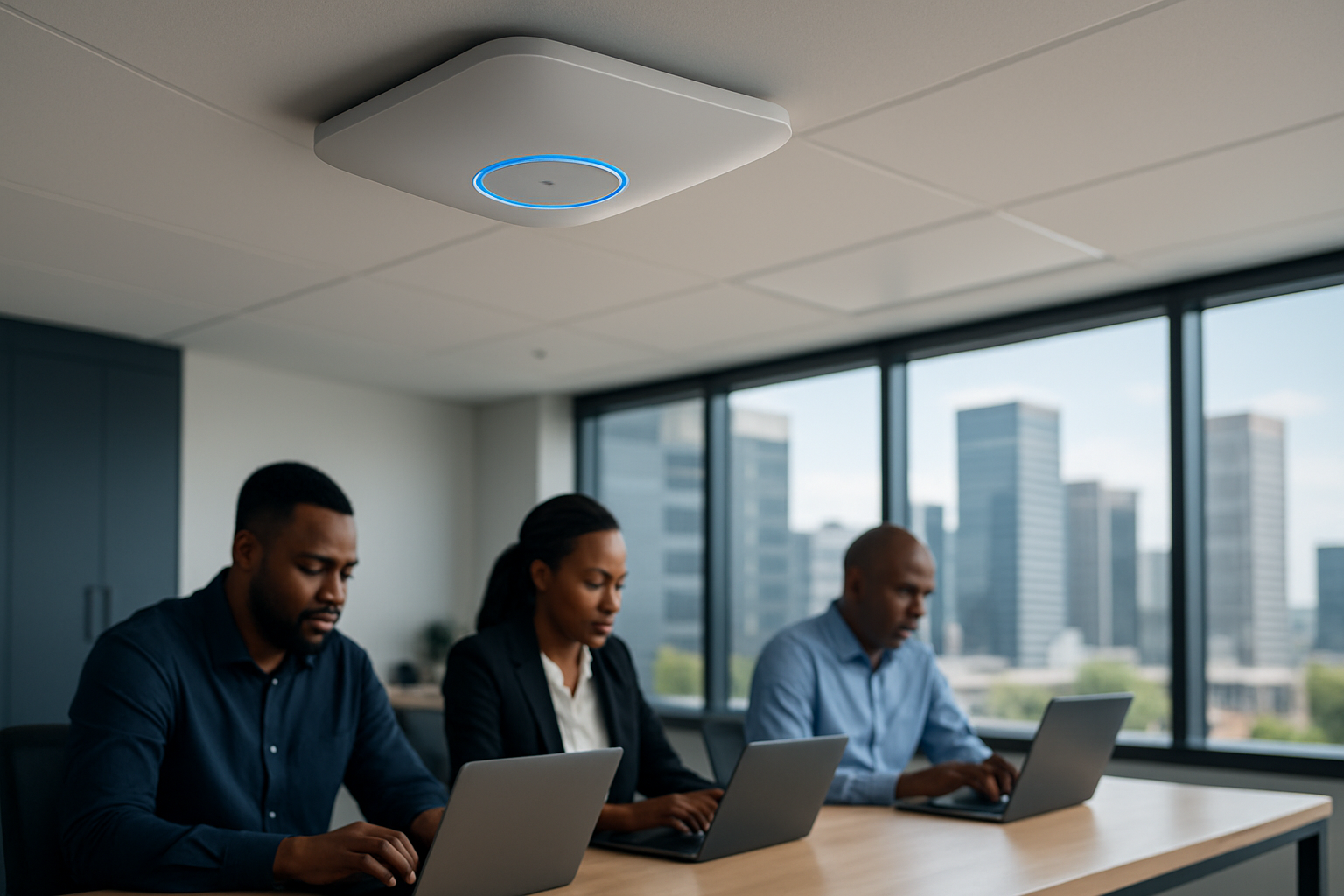
- Business access points (APs): Separate APs and controllers scale across multiple offices, offer better antenna design, and maintain consistent coverage for dozens to hundreds of clients.
Security and network segmentation
Business Wi‑Fi supports advanced security like WPA3 Enterprise, RADIUS authentication, VLANs and guest network isolation. Consumer devices typically provide WPA2 Personal and a basic guest SSID without proper client segregation.
Manageability and visibility
Managed business Wi‑Fi gives centralised monitoring, performance analytics and remote troubleshooting. Consumer routers offer minimal logging and no central policy control, making proactive maintenance difficult.
Why the differences matter for South African SMBs
SMBs in South Africa face unique pressures: competition for skilled staff, the need to maintain client trust, and the cost of downtime. Choosing the wrong Wi‑Fi approach can increase risk and operating expense.
Productivity and customer experience
Slow or unreliable Wi‑Fi directly affects staff productivity and client interactions. For retail, professional services and small clinics in Gauteng, a poor network can mean delays at point of sale, slow cloud access, or disrupted video calls with clients.
Security and compliance
Data protection is essential. Business Wi‑Fi supports stronger encryption and authentication, reducing the chance of unauthorised access to company systems and customer information.
Cost comparison: upfront vs long‑term
Consumer Wi‑Fi has a lower upfront price, but business systems deliver savings over time through reliability, lower downtime costs and easier scaling.
Upfront costs
- Consumer: One off purchase of a router from a retail store (cheaper initially).
- Business: Higher initial hardware cost for APs, controllers and cabling.
Operating costs and ROI
Consider these long‑term factors:
- Reduced downtime and fewer on‑site fixes when using professional gear and managed services.
- Better security reduces the risk and potential cost of breaches.
- Scalability means avoiding repeated replacement cycles as your business grows.
When a consumer setup might be acceptable
There are scenarios where consumer Wi‑Fi is suitable, especially for micro‑businesses or home offices with light usage:
- Single user or very small teams (1–3 people) with limited cloud usage.
- Low security requirements and minimal visitor access.
- Temporary locations or testing before committing to managed infrastructure.
However, even small firms should keep an eye on performance and security as they grow.
When to opt for business Wi‑Fi
Choose business Wi‑Fi when the network is critical to daily operations or when you need reliable support:
- Multiple users and devices, VoIP or frequent video conferencing.
- Public or guest access that must be isolated from corporate systems.
- Regulatory or client requirements for stronger data protection.
- Desire for managed services to reduce internal IT workload.
Managed Wi‑Fi vs in‑house IT
Many SMBs in Gauteng prefer outsourcing network management to focus on their core business. Managed Wi‑Fi offers predictable costs, SLAs, and access to experienced engineers who can resolve issues quickly—consistent with RandTech IT’s approach of prioritising fast resolution by experienced staff.
Benefits of managed Wi‑Fi
- 24/7 monitoring and remote fixes reduce on‑site visits.
- Regular firmware updates and security patching.
- Capacity planning and scaling advice tailored to your business.
Practical checklist for choosing the right Wi‑Fi
- Assess concurrent user numbers and typical applications (VoIP, video, cloud apps).
- Require business‑grade security: WPA3 Enterprise, RADIUS and VLANs.
- Plan for coverage: perform a site survey for proper AP placement.
- Decide on managed services vs in‑house support and review SLAs.
- Budget for cabling, professional installation and ongoing management.
FAQ
1. Can a consumer router be upgraded to meet business needs?
Sometimes you can extend a consumer router with range extenders or mesh kits, but this rarely addresses security, manageability or high client density. For reliable performance and proper segmentation, business APs remain the better option.
2. How many access points does a typical small office need?
That depends on floor area, building materials and device density. A small office (50–100 m²) often needs 2–3 APs for consistent coverage; a site survey provides an accurate count.
3. Is managed Wi‑Fi expensive for SMBs in South Africa?
Costs vary, but managed services can be cost‑effective when you factor in reduced downtime and less burden on in‑house staff. Think in terms of monthly predictability rather than a large capital outlay alone.
4. What security features should I require from a business Wi‑Fi solution?
Insist on WPA3 Enterprise or at least WPA2 Enterprise with RADIUS, VLAN support, guest network isolation and centralised logging/monitoring.
5. How quickly can issues typically be resolved with managed Wi‑Fi?
Response times depend on your service agreement. A key advantage of experienced providers like RandTech IT is faster resolution by senior engineers rather than extended troubleshooting by junior staff.
Conclusion
For South African SMBs, the choice between business Wi‑Fi and consumer Wi‑Fi comes down to reliability, security and long‑term cost. While consumer gear can work for very small or temporary setups, business Wi‑Fi—especially when managed—delivers the performance and protection required for growth and professional operations in Johannesburg and across Gauteng.
Contact RandTech IT to assess your environment and recommend a practical, cost‑effective Wi‑Fi solution. Our experienced engineers focus on fast, reliable resolutions so you can keep your business moving.